

Seven Methods of Plant Propagation: Types, Advantages, and Examples


SummaryPlant propagation is the key to multiplying healthy plants efficiently, but choosing the right method can be confusing. This guide covers the seven major propagation techniques, including seed propagation, cuttings, division, layering, grafting, budding, and plant tissue culture, to help you understand how each method works and when to use it.
Introduction
Who doesn't love filling their home with beautiful, healthy indoor plants?
But growing and maintaining them isn't always as easy as it looks.
Many people buy plants from nurseries or garden centers, only to watch them struggle or die within a few months. Others want to propagate their favorite plants but aren't sure which method to use—or even if it's possible.
The truth is, not all plants are grown the same way.
Some grow best from seeds, while others multiply much faster through cuttings, layering, grafting, or tissue culture.
Choosing the right propagation method can improve success rates, save time and money, and help you grow healthier plants.
In this article, we'll explore seven common plant propagation methods: seed propagation, cuttings, layering, division, grafting, budding, and tissue culture.
You'll learn how each technique works, when to use it, and which plants are best suited for each method.
Let's get started!
What Do We Mean by Propagation?
Plant propagation is the process of producing new plants from existing ones. It allows growers, gardeners, and researchers to multiply plants with desirable characteristics, whether for home gardening, commercial production, or conservation.
Over the years, several propagation techniques have been developed to meet different goals. Some methods are used to produce large numbers of uniform plants, while others help preserve valuable plant traits, improve disease resistance, increase productivity, or rapidly multiply plants that are difficult to grow from seeds.
Broadly, plant propagation is divided into two categories based on how new plants are produced:
Sexual propagation: Plants are grown from seeds produced through fertilization.
Asexual (vegetative) propagation: New plants are produced from stems, roots, leaves, or other plant parts without the use of seeds.
Each method has its own advantages, limitations, and ideal applications.
Choosing the right propagation method depends on factors such as the plant species, desired growth rate, cost, and the characteristics you want to preserve.
Let's explore them in detail.
Sexual Propagation
Sexual propagation is the production of new plants through the fertilization of male and female reproductive cells. During this process, pollen fertilizes the egg, resulting in the formation of seeds. Because new plants are produced from seeds, this method is also known as seed propagation.
It is one of the oldest, simplest, and most widely used methods of plant propagation.
Sexual propagation is commonly used for ornamental plants, vegetables, fruit crops, medicinal plants, and many field crops.
One of the biggest advantages of seed propagation is genetic diversity. Since each seed contains a unique combination of genes from its parent plants, it allows breeders to develop new varieties and cultivars with improved traits such as higher yield, better quality, pest and disease resistance, or improved environmental adaptability.
In addition, seeds are generally inexpensive, easy to transport, and can often be stored for long periods under suitable conditions.
However, seed propagation also has several limitations:
- Seed-grown plants often take longer to flower and produce fruit because they must pass through a juvenile growth stage.
- Plants propagated from seeds are not genetically identical to their parents, making it difficult to maintain uniform characteristics.
- Some plant species produce few or no viable seeds, while others have seeds with low germination rates or dormancy issues. As a result, large-scale production of genetically identical plants can be challenging.
For these reasons, growers often use asexual (vegetative) propagation when they need rapid multiplication, true-to-type plants, or propagation of species that cannot be grown reliably from seeds.
Asexual Propagation
Asexual propagation, also known as vegetative propagation, is the production of new plants from vegetative parts such as stems, leaves, roots, or modified plant organs, without the formation of seeds.
Since no fertilization occurs, the resulting plants are genetically identical to the parent plant. These genetically identical plants are known as clones.
Vegetative propagation is widely used in horticulture, agriculture, and commercial nurseries because it allows growers to rapidly multiply plants with desirable traits while maintaining uniformity.
It is especially useful for propagating seedless plants, plants that produce non-viable seeds, or species that are difficult to grow from seeds.
Common methods of asexual propagation include cuttings, division, layering, grafting, budding, and plant tissue culture.
One of the greatest advantages of vegetative propagation is the ability to produce large numbers of true-to-type plants that retain the exact characteristics of the parent plant.
These plants often mature faster than seed-grown plants, resulting in earlier flowering and fruiting. The method also enables the propagation of elite cultivars and genetically superior plants on a commercial scale.
However, vegetative propagation also has some limitations:
- Since all propagated plants are genetically identical, there is little to no genetic variation, making it difficult to develop new varieties through this method alone.
- In addition, diseases and viruses present in the parent plant can be transmitted to all propagated plants if healthy starting material is not used.
- Many vegetative propagation techniques also require specialized skills, careful handling, and, in some cases, controlled environmental conditions.
Despite these limitations, vegetative propagation remains the preferred method for producing uniform, high-quality plants and is widely used in modern commercial horticulture.
1. Cutting
Cutting is one of the simplest and most widely used methods of vegetative propagation.
It involves removing a vegetative part of the parent plant—such as a stem, leaf, or root—and placing it under suitable conditions so it develops new roots and shoots, eventually growing into a complete plant.
Depending on the plant part used, cuttings are classified into three main types:
- Stem cuttings
- Leaf cuttings
- Root cuttings
Cuttings are also categorized based on the maturity of the parent stem. These include:
- Herbaceous cuttings (from soft, non-woody plants)
- Softwood cuttings (from young shoots of shrubs and trees)
- Hardwood cuttings (from mature woody stems of deciduous or evergreen shrubs)
Rooting hormones such as IBA (Indole-3-butyric acid) or NAA (Naphthaleneacetic acid) are commonly used to improve root formation in many plant species.
One of the biggest advantages of this method is that it is simple, inexpensive, and produces plants that are genetically identical to the parent, often with earlier flowering and fruiting than seed-grown plants.
However, not all plant species root easily from cuttings, and success depends on factors such as the type of cutting, environmental conditions, and proper care. Diseases present in the parent plant can also be passed on to the new plants.
This method is commonly used for: Tomato, Sunflower, Marigold, Corn, Wheat, Beans, Peas, Papaya.

2. Division
Division is a vegetative propagation method commonly used for perennial plants (plants that live for more than two years).
It involves digging up a mature plant, dividing it into smaller sections, and replanting each division in a prepared site. Each section must contain healthy roots and shoots so it can establish and grow independently.
This method is widely used for propagating herbaceous perennials and, in some cases, woody shrubs. For woody plants, division should be carried out during the dormant season to minimize stress. While separating the plant, care should be taken to avoid damaging the roots or growing points.
The main advantages of division are that it is simple, inexpensive, produces genetically identical plants, and helps rejuvenate overcrowded plants by reducing competition for water and nutrients.
However, it is only suitable for plants that naturally form multiple crowns or clumps, and excessive root damage during division can reduce plant survival and growth.
This method is commonly used for: Peace Lily, Hosta, Daylily, Agapanthus, Aloe Vera, Ornamental Grasses, Ginger.

3. Layering
In this technique, the attached and bent branch of the plant is covered with soil and allowed to root.
After the emergence and development of roots, that specific part of the plant is cut and allowed to grow as a new plant. This is called ‘layering’.
Different types of layering techniques include:
- Simple Layering: A shoot or branch is bent, a part of it is buried in the soil, and the tip of the plant sticks out.
- Compound Layering: Similar to simple layering, but with a longer, flexible branch. Cover parts with soil and leave parts exposed alternately.
- Tip Layering: For plants with long branches, put the tip of a new branch into the ground to grow.
- Mound Layering: When the plant is dormant, cut it at ground level and cover it with soil.
- Air Layering: Here, the new roots grow above the ground. Choose a branch and remove a strip of bark, then cover the area with special soil and a plastic cover.
This method is commonly used for: Jasmine, Bougainvillea, Blackberry, Raspberry, Grapevine, Magnolia, Rubber Plant.

4. Grafting
This involves cutting a twig of one plant and joining it with the stem of another plant in such a manner that they form a unit and function as one plant. It is a bit of a complex process but allows you to bring the desired character to your plant. However, be sure to sterilize your hands and tools to prevent the transfer of infections during the process.
To obtain a successful union of attached plants, ensure the following factors:
- The rootstock and scion chosen for the process are compatible
- Both plant parts are at a suitable physiological stage
- The cambium of both parts is in contact
- The union point is not dry, and there's no infection
This method is commonly used for: Mango, Apple, Citrus (Orange, Lemon), Pear, Avocado, Guava, Rose.
Vocabulary
- Scion: the upper portion of the graft.
- Rootstock: the lower portion that provides roots.

5. Budding
Budding is a vegetative propagation method in which a single bud from the desired plant (scion) is inserted into a cut made on the rootstock.
The two parts are secured together until they unite and grow as a single plant.
This technique is commonly used for fruit trees, roses, and ornamental plants. Its main advantages are that it requires only one bud, produces true-to-type plants, and combines the desirable traits of the scion and rootstock.
However, successful budding requires compatible plant species, proper timing, and skilled handling.
This method is commonly used for: Citrus (Orange, Lemon, Lime), Peach, Plum, Cherry, Rose, Rubber Plant.
6. Tissue Culture
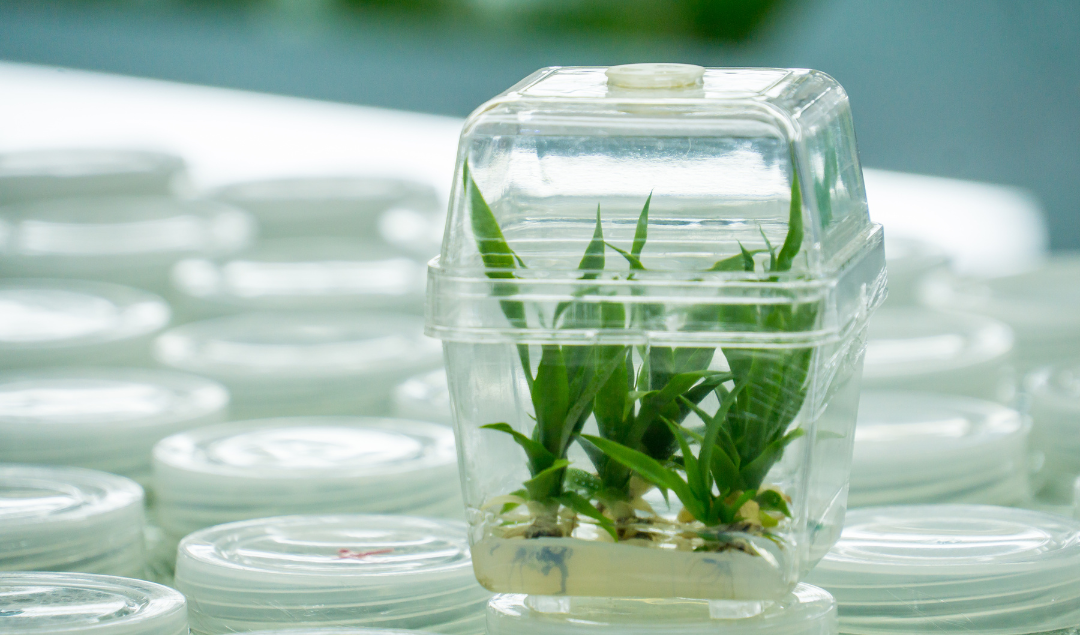
Plant tissue culture is the most advanced method of plant propagation, in which small pieces of plant tissue (explants) are grown on a nutrient medium under sterile and controlled laboratory conditions.
It is widely used for the commercial production of genetically identical plants and the rapid multiplication of elite cultivars.
Unlike conventional propagation methods, plant tissue culture begins with a small piece of plant tissue (called an explant) grown on an artificial nutrient medium under sterile, controlled laboratory conditions.
This enables the rapid, year-round production of large numbers of genetically identical, disease-free plants, making it an essential technique in modern horticulture, agriculture, plant conservation, and research.
This method is commonly used for: Banana, Orchid, Potato, Sugarcane, Bamboo, Strawberry, Date Palm, Blueberry, Anthurium, Philodendron, Monstera, Aglaonema, Spathiphyllum (Peace Lily), Syngonium, and many more.
Advantages of tissue culture technique:
Plant tissue culture offers several advantages over conventional propagation methods, making it the preferred technique for commercial plant production and research.
- Produces true-to-type clones that are genetically identical to the parent plant.
- Preserves desirable characteristics of elite cultivars.
- Enables the propagation of seedless plants and species that are difficult to grow using conventional methods.
- Produces large numbers of plants in a relatively short period of time.
- Generates disease-free planting material under sterile laboratory conditions.
- Supports year-round, large-scale commercial plant production.
- Improves productivity by providing uniform, high-quality plants.
-
Makes the exchange and transportation of disease-free plant material easier.
The best propagation method depends on the type of plant you want to grow, your propagation goals, and the time, resources, and effort you're willing to invest.
Choose the technique that best suits your needs, and start growing your own healthy, thriving plants!
Ready to Master Plant Tissue Culture? Plant Cell Technology Can Help.
Plant Cell Technology is helping tissue culturists around the world by providing unique and world-class products and services that streamline their tissue culture workflows. It has MS media, agar, gellan gum, Plant Preservative Mixture (PPM), culture vessels, Biocoupler (TM), and masks in its store to facilitate your processes.
And that’s not it! Plant Cell Technology also offers consultation services to culturists of all sizes that help to get instant solutions to your tissue culture problems.
However, if you're willing to learn directly from an expert, we've got you covered!
Our comprehensive tissue culture master classes are designed to teach you everything about tissue culture, ranging from theoretical concepts to hands-on experience in explant and media preparation, multiplication, rooting, and acclimation of plants. Additionally, it also covers advanced tissue culture techniques, such as shoot apical meristem and synthetic seed production, to make you the next pro in the industry.
Our masterclasses are taught by tissue culture experts with experience of 10-20 years in the field. They not only help you learn the tissue culture concepts but also share their personal success and failure stories to learn from them and start your tissue culture journey with a bang.
Seems like something long-awaited? So, why wait?
Sign up for your choice of tissue culture master class TODAY and excel in your tissue culture game!
References
- NCERT. Principles of Plant Propagation, Methods of Propagation for Horticultural Crops. https://ncert.nic.in/vocational/pdf/kegr103.pdf
- Resource Central. Plant Propagation Methods. https://resourcecentral.org/plant-propagation-methods
- Wikipedia. Plant Propagation. https://en.wikipedia.org/wiki/Plant_propagation
- University of Maine Cooperative Extension. Plant Propagation Manual. https://extension.umaine.edu/gardening/manual/propagation/
- Wikipedia. Plant Tissue Culture. https://en.wikipedia.org/wiki/Plant_tissue_culture
- Toppr. Explain Grafting in Plants. https://www.toppr.com/ask/question/explain-grafting-in-plants/
- Grow Organic. How to Propagate Plants. https://www.groworganic.com/blogs/articles/how-to-propagate-plants
- Gardeners' World. Five Methods of Plant Propagation. https://www.gardenersworld.com/plants/five-methods-of-plant-propagation/
- Major Differences. Difference Between Sexual and Asexual Plant Propagation. https://www.majordifferences.com/2013/03/difference-between-sexual-and-asexual-propagation.html
Blog Categories
View by Level
Popular Blogs

The Commercial Importance of Plant Tissue Culture
Summary Plant tissue culture is a multi-billion-dollar commercial engine for agribusiness and biopharma, enabling rapid, year-round micropropagation of uniform, true-to-type...
Read More
The Best Agar for Plant Tissue Culture
Summary Agar plays an important role in plant tissue culture, but choosing the right one can be confusing. This blog...
Read MoreFollow Us On Social


Follow Us On Social
Join the conversation
Your email address will not be published. Required fields are marked